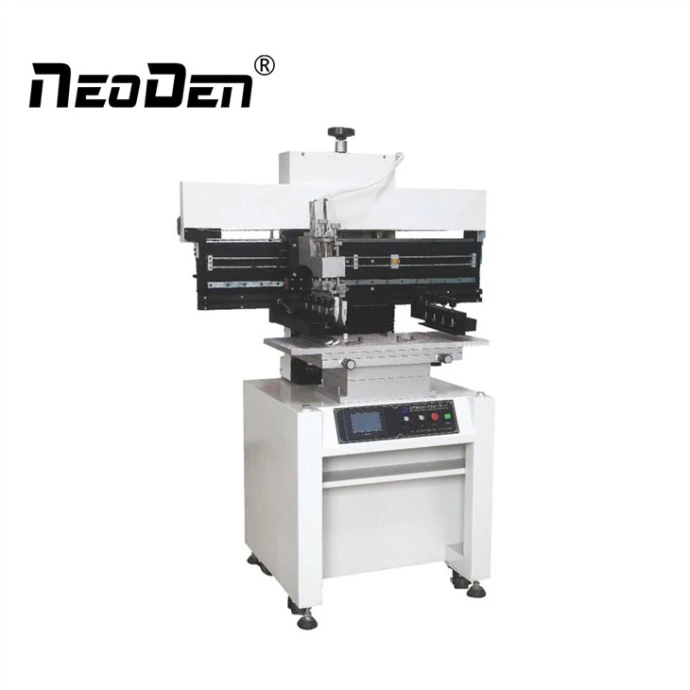
NeoDen YS350 Semi-Automatic Screen Printer
■ Semi-Automatic Printer
■ 400 mm * 240 mm Maximum PCB Size
■ PCB Thickness of 0.2 mm ~ 2.0 mm
■ 500 * 320 mm Printing Area
The NeoDen YS350 semi-automatic screen printer is used for high-precision and flexible PCB screen printing.
NeoDen YS350 Semi-Automatic Screen Printer
Description
Control System
Microcomputer Control
Touch Screen
Menu User Interface
Touch Screen Interface
Time Display Function
Automatic Print Time Counting Function
Scrapers
Similar to the fully automatic printing machine, the scraper can move freely up and down.
The scraper pressure is adjustable according to the different scraper model.
The stop time of the scraper at the upper left/right and lower left/right positions can be set independently.
The speed of the scrapers can be adjusted.
Emergency stop of the scrapers to maintain safety.
Stencil
Similar to the fully automatic printing machine, the stencil will slowly rise in 2 seconds to demold.
then quickly rise to exit the PCB, preventing smearing during demolding
and saving time while improving production efficiency.
PCB Positioning
Positioning of reference holes
Positioning of reference edge
Specification
| Product name | Semi-automatic screen printer | Thickness of the printed circuit board | 0.2-2.0 mm |
| Mix of PCB sizes | 400*240mm | Air source | 4-6 kg/cm2 |
| Printing area | 500*320mm | Power supply | AC 220 V 50 Hz. |
| Frame size | Length(550-650)*Width(370-470)mm | Dimension | Length 800*Width 700*Height 1700 (mm) |
| Printing/repeat accuracy | +/-0.2 mm | Packaging size | 1050*900*1850 (millimeter) |
| N.W./G.W. | 230/280 kilograms |
Quality control
We have a quality control person who stays on the production lines to perform inspections.
All products must have been inspected before delivery. We conduct inline inspection and final inspection.
1. All raw materials are checked once they arrive at our factory.
2. All parts, logos, and all details are checked during production.
3. All packaging details are checked during production.
4. All production and packaging quality is checked in the final inspection once completed.
VIDEO
Help Center: SMT Printing Process Optimization
1. What causes the accumulation of paste in the openings of the stencil?
The retention of welding in the cavities is usually the result of three critical factors:
Window Geometry: To facilitate demolding, conical sloped walls are recommended (typical of laser cutting).
Pasta properties: It is suggested to use Type 3 or 4 alloys with a viscosity range between 800 and 1200 kcps.
Weather conditions: A relative humidity below 40% accelerates the drying of the paste, increasing its adhesion to the metal.
2. Guide to Maximizing the Durability of the Squeegee
To avoid premature replacement of the leaves, follow these guidelines:
Material selection: Use polyurethane with a hardness of 60–80 Shore.
Usage cycles: It is recommended to rotate or flip the position of the blade every 4 to 8 hours of operation to ensure balanced wear.
Protection: Storage should be in environments protected from sunlight and moisture to prevent the material from crystallizing or degrading.
3. Strategies for an efficient paste transfer
To ensure that the welding is deposited accurately on the plate:
Coordine el espesor de la plantilla con el pitch de los componentes (ej. 0.1 mm for encapsulated components 0201).
Prioritize high-quality finishes, such as laser cutting combined with electropolishing, to smooth the internal walls.
Stabilize the work area to25°C (±2)and a humidity of50% (±10).
Opt for pastes with a metallic density between90% and 95%.
4. Main causes of blurry or defective prints
If the print definition is poor, check the following points:
Force adjustment: The pressure on the squeegee should be set between 4 and 6 kg.
Equipment lifespan: Check if the blades have exceeded the limit of 50k–80k prints.
Output parameters: Adjust the separation speed between the stencil and the circuit to 0.1–0.5 mm/s.
Hygiene protocol: Systematically clean the underside of the stencil every 10 or 15 cycles.
5. Why are there variations in deposit thickness?
Lack of uniformity in paste height often results from:
Stencil tension: Poor tension (below 35N/cm²) causes irregularities.
PCB stability: Insufficient support of the board; it is recommended to placeone support pin for every 100 cm².
Mechanical setup: The blade's angle of attack must remain constant at 60° (±5).
Thermal management: Keep the paste temperature below 26°C to prevent it from losing its structural shape.